
June 26, 2020

If you feel like you’re living a scene from “Office Space” every time you’re asked to review another slightly irrelevant or repetitive report, then it’s time to assess your organization’s data strategy, beginning with report rationalization.
Report rationalization is a critical step to align your organization’s overall strategy and data strategy.
Companies and nonprofits spend substantial time, energy, and resources creating a strategic plan to achieve success and executing toward that. However, if the leaders, managers, and individual contributors in those organizations do not have the data they need to assess their progress or discover opportunities, that strategy can just be a set of ideas.
To create an actionable strategic plan, your organization needs a data strategy that supports and drives it. At a high level, a data strategy establishes the flow of data within the organization, creates trust, allows for empowerment, and removes manual processes and intervention. One of the first steps to create a data strategy is implementing a report rationalization process, which can help discover efficiencies to an organization’s data processes. It also solves a huge burden that many organizations face: report overload.
Most organizations are swimming—or treading water—in a vast sea of data. From website analytics to CMS reports, to POS dashboards, the amount of information available is astounding.
To get a handle on that amount of data, many create ad-hoc processes that involve manual analysis, endless spreadsheets, and, of course, reports.
As an organization grows, the amount of information flowing into also increases—as does the complexity of managing that much data and reports. This growth can adversely affect revenue, employee engagement, and efficiency. Some of the ways we see reporting proliferation negatively impact organization include:
All four of these factors result in the most significant impact on organizations—which is lost revenue. We know that businesses that rely on data management tools to make decisions are 58% more likely to beat their revenue goals than non-data driven companies, according to a Forrester Consulting study commissioned by Collibra. The same survey found that data-savvy businesses are 162% more likely to have significantly surpassed their revenue goals when compared to their "laggard" counterparts.
So, report proliferation will cost your organization money, time, opportunity, engagement, and trust. But how did you get to have too many reports in the first place?
Excessive and redundant reporting practices usually have one or both of the following root causes: a lack of a defined reporting process or a duplication of efforts across department areas. Often, these issues are intertwined and can even rely on one another.
An undefined reporting process is often the result of three factors:
A lack of ownership can cause duplication of effort across departments and areas. For example, sales may pull a report in one way, while marketing pulls the same information in a slightly different format with a different definition. The results in this example will be inconsistent and require multiple resources to spend time gathering or analyzing the same information.
If your organization suffers from over-reporting, then it’s time to clean house with report rationalization. Think of it as bringing in the Marie Kondo of data into your organization.
A report rationalization is essentially cleaning your “reporting closet.” Through it, you will identify critical reports and identify those that are unnecessary or redundant. The process includes three key steps:
During this first step, your organization will create a list of all reports by department or functional area to understand all the information that exists in the organization. Reports can be any type of data/information that is documented through spreadsheets, documents, PDFs, emails, or systems.
Deciding who is responsible for each report creates accountability for the contents of the report. It also establishes a process for making changes to the report or answering questions about its importance. For each report, the owner will need to provide the following information:
Once you know what reports your organization is currently producing and the ownership of each, it’s time to evaluate. Review each report against the following criteria to see where there is overlap or gaps to fix as needed.
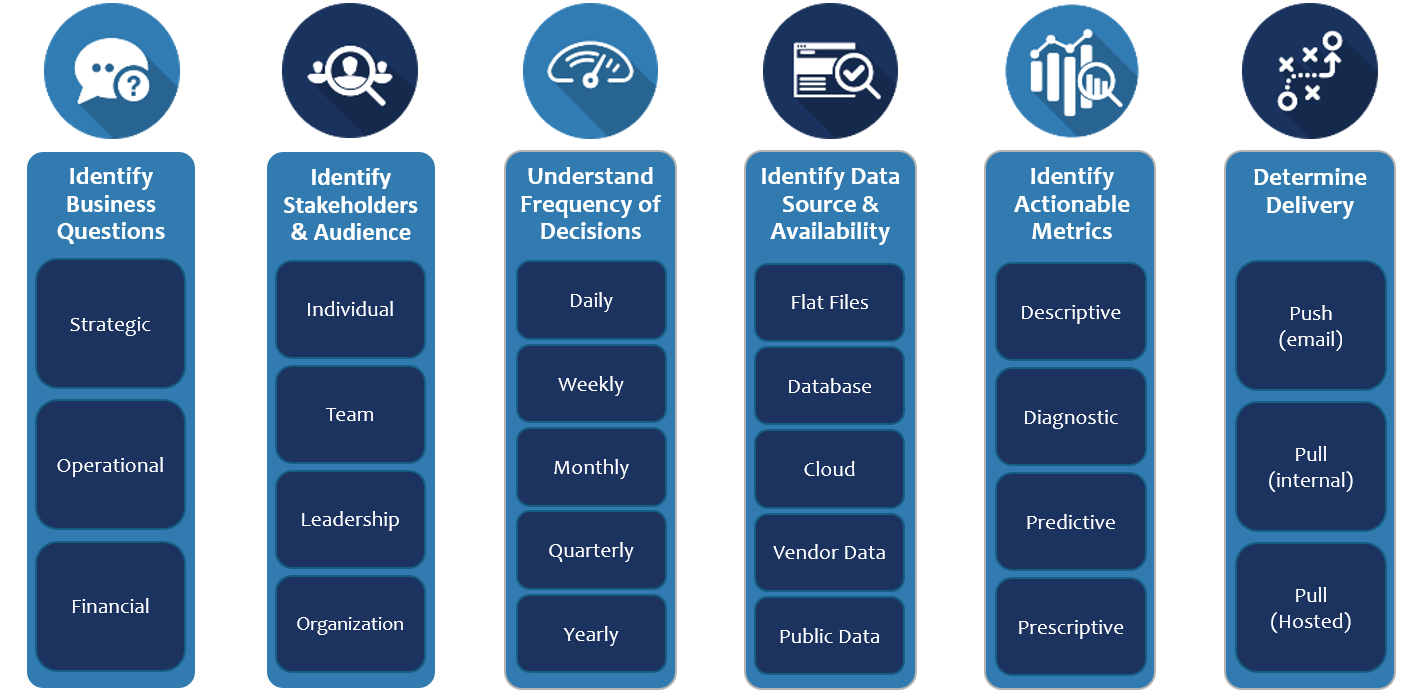
A report rationalization is the beginning of a process to help your organization understand better the data it uses, simplify the overall reporting demands, and change the report processes to deliver more value. By applying report rationalization and other business intelligence practices, your organization can align its strategic plan with its data strategy to get better results.